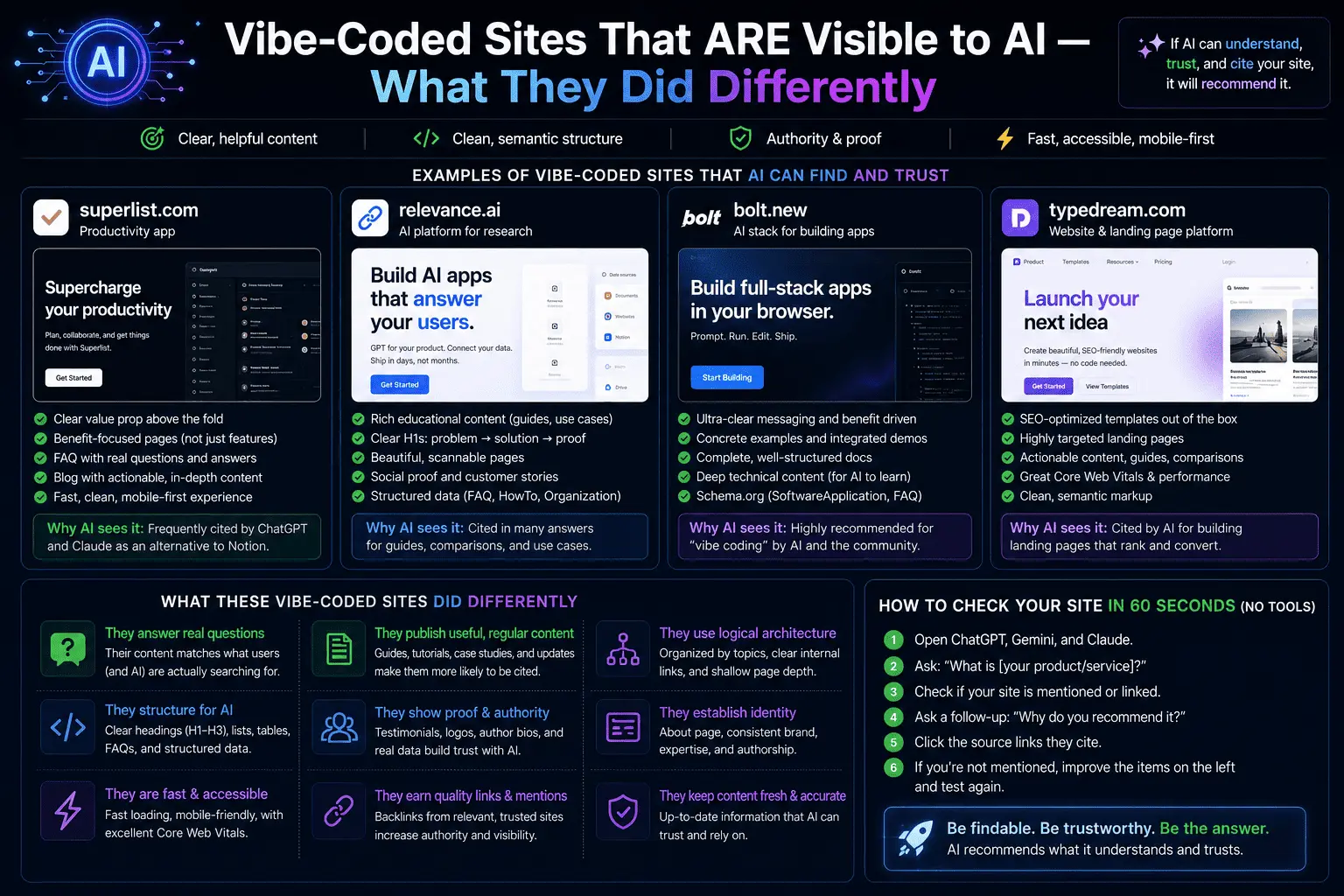
Most vibe-coded sites are effectively invisible to AI search engines. But a minority are readable — and some are genuinely well-optimized. Here's exactly what separates them from the crowd.
Why we looked for the exceptions
Our audit data tells a bleak story: across the 301 sites we've scored, 83.4% fall below 50/100 for AI visibility and 57.1% are below 30. But the flip side is that a real share of sites are at least partially visible — and the best of them are readable, citable, and showing up in AI answers.
We pulled the top-scoring vibe-coded sites we've audited and reverse-engineered what they'd done. The patterns were consistent.
What every high-scoring site had
1. Server-rendered or pre-rendered HTML
Every top-scoring site served real, readable HTML to crawlers — not a blank root div. The methods varied: some used Next.js with static generation, some added a prerender service in front of their Lovable app, some moved key landing-page content into a traditionally rendered wrapper. The common thread: run curl on their homepage and you get actual text back.
2. At least one JSON-LD block
All of them had structured data — typically a Product or Organization schema — in the page head. This tells AI crawlers not just what the page says but what it means: this is a SaaS tool, it costs X, it does Y.
3. A working llms.txt file
Most of the top sites had an llms.txt file at their root. This file, which takes about ten minutes to write, tells AI language models what the site is about and which pages matter most.
4. Descriptive, keyword-rich headings
Their H1 and H2 tags answered specific questions — "Why can't ChatGPT find your site?" rather than "Welcome to our platform." AI crawlers weight headings heavily when deciding what a page is about and whether to cite it.
5. A robots.txt that explicitly allows AI crawlers
Every high-scoring site had a robots.txt that either allowed all bots or explicitly whitelisted GPTBot, ClaudeBot, and PerplexityBot. None relied on the default configuration.
The one thing that matters most
If we had to pick a single factor, it's the HTML rendering. Without readable content in the initial response, structured data, llms.txt, and headings all become secondary. Fix the rendering first. Everything else compounds from there.
How to check your own site
Open your terminal and run:
curl -s yourdomain.com | head -100
If you see a blank div or a script tag without surrounding text, your site has the rendering problem. If you see actual words from your homepage, you're in better shape than most.
For a complete picture — across all six categories we audit — run a free scan at searchaudit.io.
Part of SearchAudit's series on AI visibility in vibe-coded sites. Related: Bolt.new and AI Visibility.