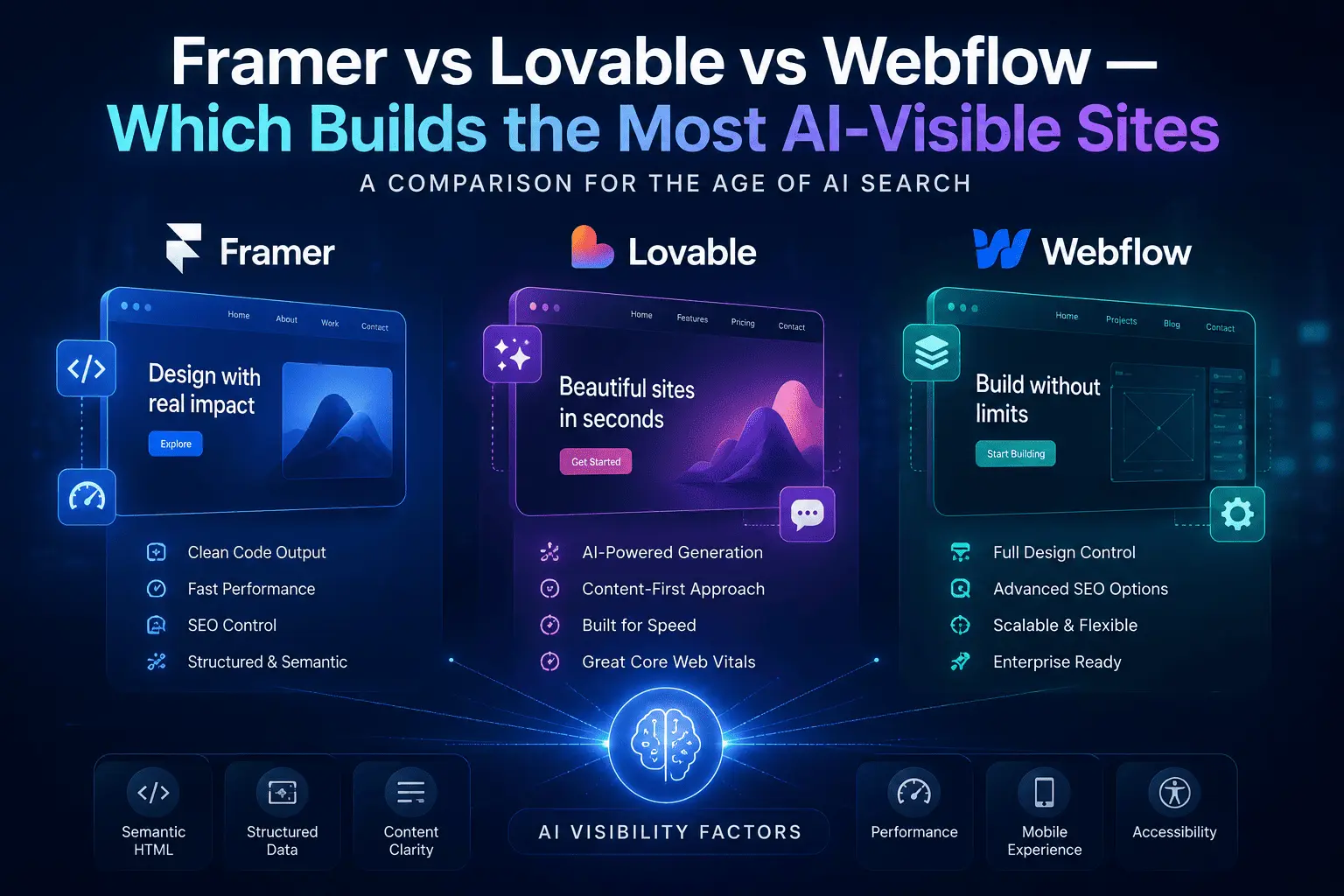
We ran sites from all three platforms through SearchAudit's full audit. The ranking isn't what most people expect.
Why this comparison matters
The no-code and vibe-coding space has fractured into two camps: AI-first builders like Lovable and Bolt, and more traditional visual builders like Framer and Webflow. Both camps produce sites that look great in a browser. But how they perform for AI search engines is a different story.
We audited a batch of public sites from each platform. Here's what we found.
The results
Webflow — the strongest performer
Webflow generates server-rendered HTML by default, which means AI crawlers get actual content when they fetch a Webflow site. That single architectural choice puts it clearly ahead. The main weaknesses we see: structured data is still frequently missing, and llms.txt adoption is rare.
Framer — a solid middle ground
Framer sites tend to have better metadata than Lovable or Bolt, and the platform has added server-side rendering features in recent updates. Structured data remains uncommon, and robots.txt configurations are inconsistent — but readable HTML is far more likely than on a pure client-rendered build.
Lovable — the weakest of the three
Consistent with everything else we see across vibe-coded sites: the core problem is client-side rendering with no prerender layer, so AI crawlers receive an empty root div on the large majority of sites.
The key insight
The gap between Webflow and Lovable isn't primarily about features or templates. It comes down to one architectural decision: does the server send real HTML, or does it send JavaScript that builds the page after the fact?
Webflow made the HTML-first choice. Lovable and Bolt made the React-first choice. Both are valid for human visitors. Only one works for AI crawlers in their current form.
Does this mean you should switch platforms?
Not necessarily. The rendering problem is fixable without abandoning your builder. A prerender layer, static generation, or a server-side-rendering wrapper can lift a Lovable site's AI visibility dramatically without a rebuild.
The platform choice matters less than whether you've addressed the rendering layer. A poorly configured Webflow site can still fail AI audits. A well-configured Lovable site can pass them.
The bottom line
If you're choosing a platform today and AI search visibility is a priority, Webflow has the structural advantage. If you've already built with Lovable or Bolt, fixing the rendering layer is the move — not migrating.
Run a free audit at searchaudit.io to see where your site sits, regardless of which platform you used.
Related: Bolt.new and AI Visibility and Why ChatGPT Can't Read Your Lovable Site.