There's a file almost no vibe-coded site has. It takes about ten minutes to create. And it's one of the clearest signals you can send to AI search engines that your site exists and wants to be cited.
What is llms.txt?
llms.txt is a plain-text file placed at the root of your website — the same location as robots.txt — that tells AI language models what your site is about, what content is available, and how they should use it.
The format was proposed in 2024 and has since been adopted by a growing number of tools, docs sites, and developer platforms. AI crawlers from Perplexity, Anthropic, and others have started reading it.
Think of it as a handshake between your site and every AI system that visits it.
What goes in the file?
A basic llms.txt looks like this:
# SearchAudit.io

> SearchAudit.io scans any website in 60 seconds and returns an AI Visibility Score — a 0–100 rating that shows exactly what AI search engines (ChatGPT, Gemini, Claude, Perplexity) can and cannot read on your site.

## Product
- [Free Audit](https://searchaudit.io/#top): Scan your URL, no signup required
- [Pricing](https://searchaudit.io/pricing): Plans for individuals and teams
- [Features](https://searchaudit.io/#features): Full breakdown of what we check

## Blog
- [Bolt.new and AI Visibility](https://searchaudit.io/blog/bolt-new-ai-visibility)
- [Why ChatGPT Can't Read Your Lovable Site](https://searchaudit.io/blog/why-chatgpt-cant-read-your-lovable-site)
Why does it matter for vibe-coded sites specifically?
Sites built with Lovable, Bolt, and v0 face a double problem. First, their HTML is often empty — AI crawlers can't read the main content. Second, even when some HTML is present, there's no file telling AI systems what the site is actually about.
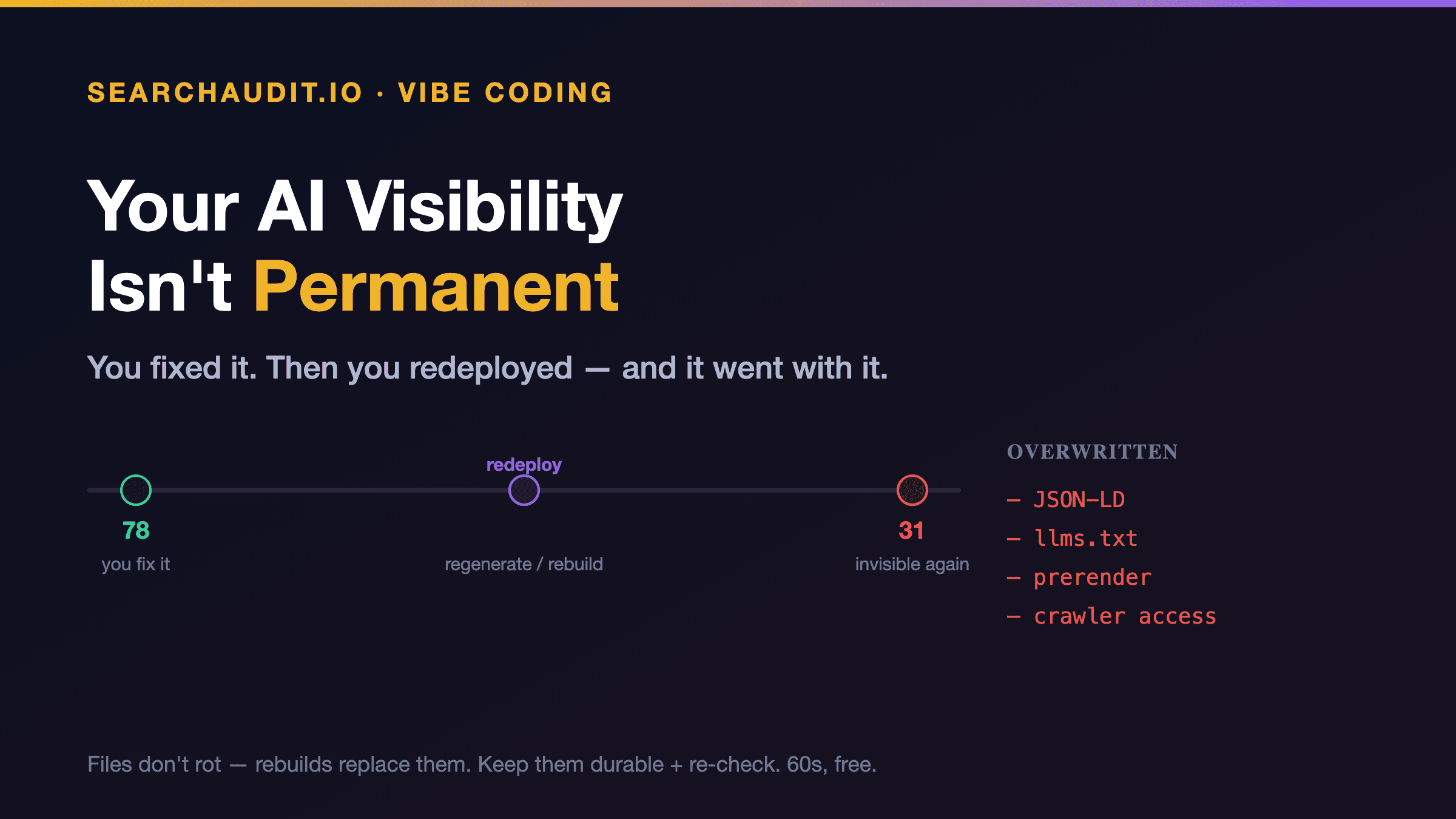
llms.txt doesn't fix the empty-HTML problem — that requires a technical fix at the rendering level. But it adds a layer of context that helps AI systems understand and cite your site even with partial content access.
In practice, almost none of the vibe-coded sites we scan have an llms.txt file. That's a wide-open gap you can close today.
How to create one
- Open a plain text editor (Notepad on Windows, TextEdit on Mac)
- Write your site name, a one-sentence description, and links to your main pages
- Save the file as llms.txt (not llms.txt.txt — check your file extension)
- Upload it to the root of your domain: yourdomain.com/llms.txt
- Verify it's live by visiting the URL in your browser
What about the technical rendering problem?
llms.txt is one piece of the puzzle, not the whole solution. If your site's HTML is still returning an empty root div, AI crawlers still can't read your core content. Run a free audit at searchaudit.io to see your full score across all six categories — crawlability, schema, semantic HTML, AI files, meta tags, and vibe-code detection.
llms.txt was proposed by Jeremy Howard and has been adopted by tools including Perplexity, Cursor, and others. The full spec is at llmstxt.org. Related: Bolt.new and AI Visibility.