Ask a question today and watch what you actually do. You don't open ten blue links and compare them anymore. You type it into ChatGPT, or Perplexity, or you read the AI Overview that sits on top of Google before the results even start — and you take the answer. One answer. Maybe two or three sources cited inside it.
That small change in habit is the biggest shift in how people find things since the search box itself. And it quietly breaks an assumption most site owners still run on: that if you're on Google, you're findable.
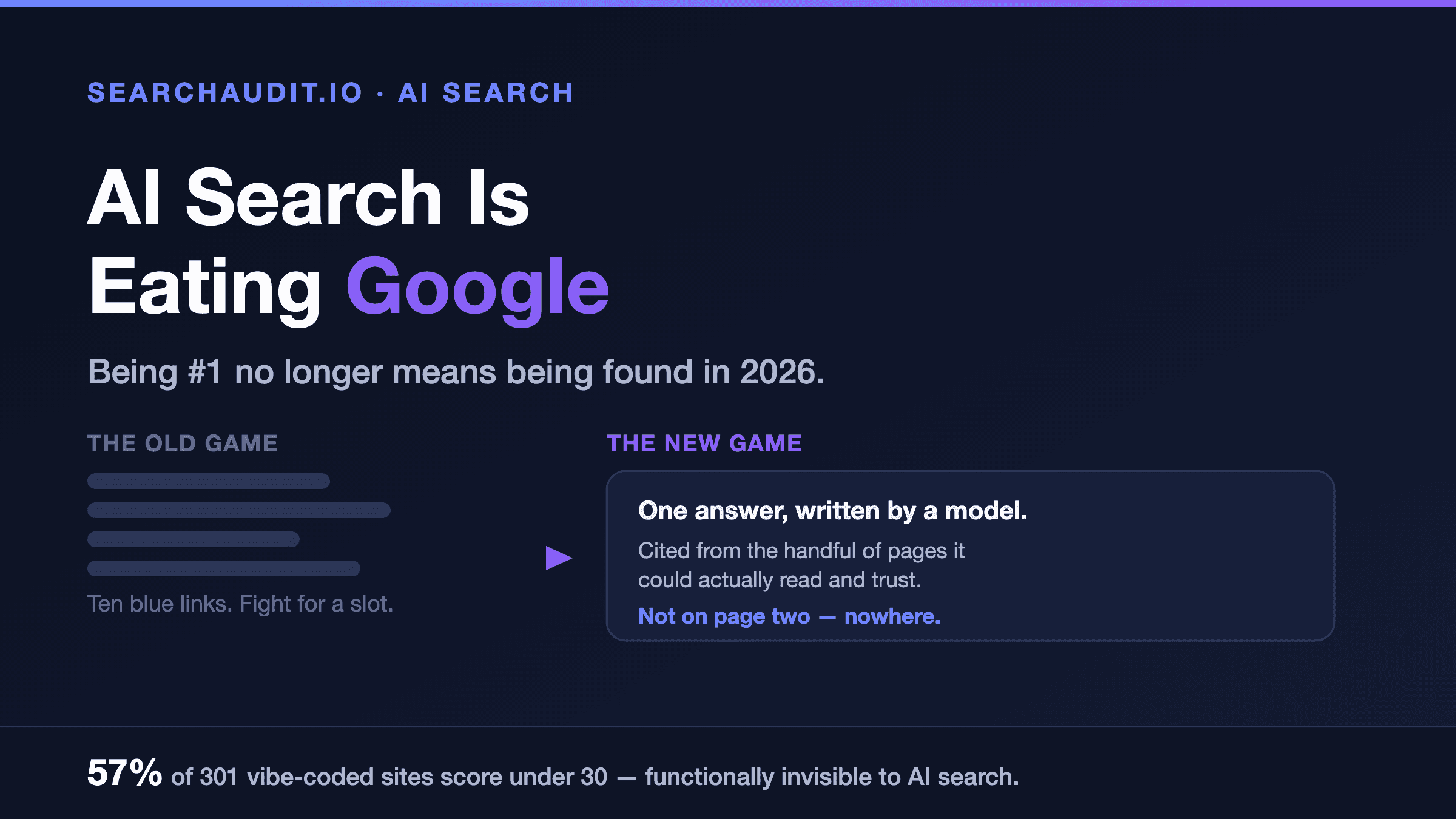
You're not. Not necessarily. You can rank #1 for your own name and still never appear in the answer someone reads. Because the answer isn't a list of links — it's a synthesis, written by a model, from the handful of pages it could actually read and trust. If your site isn't one of them, you're not on page two. You're nowhere.
The old game and the new game are not the same game
Classic SEO was a ranking contest. Ten slots, and you fought for a higher one. Being on the page was table stakes; being near the top was the win.
AI search isn't a ranking contest. It's a citation contest, and the rules are different in a way that catches people off guard:
There are no ten slots. An AI answer might cite three sources, or one, or none from anyone in your space. The model doesn't "browse" the way you'd hope. It works from what it can read cleanly and parse into facts. A page it can't read is not ranked low — it's simply absent from the pool. It rewards being legible and unambiguous — clear text, clear structure, clear statements of who you are and what you do — over being clever.
So the question flips. The old question was "where do I rank?" The new one is "when someone asks about what I do, can the model read my site well enough to quote it?" Those are not automatically the same thing, and for a lot of sites the answer to the second is no even when the first looks fine.
Why vibe-coded sites get hit hardest
Here's where it stops being abstract. We scored 301 vibe-coded sites — real sites built with tools like Lovable, Bolt and v0 — for exactly this: how readable they are to AI search. The full study is here, but the headline numbers tell the story:
Average AI Visibility Score: 35.9 out of 100. Median: 27. 83.4% scored under 50. 57.1% scored under 30 — functionally invisible to AI search. Only 2.7% cleared 90.
These aren't broken or ugly sites. Many look great and, for all we know, do fine in classic search. They score low because of how they're built: the page renders in the browser with JavaScript, so a crawler that doesn't run scripts gets an empty shell instead of your content. There's no llms.txt telling AI tools what you do. There's no structured data stating it in a form a model can lift cleanly. (We break down the mechanics in Why ChatGPT Can't Read Your Lovable Site.)
That gap didn't matter much when the only audience was Google's crawler, which has gotten good at rendering JavaScript. It matters enormously now that the audience includes models that mostly don't.
"But my SEO is handled"
Maybe it is. That's the trap. SEO being handled tells you Google can find and rank your pages. It tells you nothing about whether ChatGPT can read them, whether Perplexity will cite them, or whether you show up in an AI Overview. Those run on different plumbing. A site can be a model SEO citizen and an AI-search ghost at the same time — and increasingly, the audience that matters is moving to the side where it's a ghost.
This isn't a reason to throw out SEO. Keep it. It's a reason to stop treating "SEO done" as "findability done," because a growing share of the questions you want to be the answer to are being asked somewhere Google's ranking doesn't reach.
What to actually do about it
The good news is that being readable to AI is not a rebuild and not a subscription. It comes down to three things, and none of them touch how your site looks: serve real HTML so crawlers get content instead of an empty shell, add an llms.txt, and add structured data. We walk through all three, on five different stacks, in The Same AI-Visibility Fix, Five Different Stacks.
But the first move is just to find out where you stand — because most people are guessing. Run a free audit: paste your URL, and in about 60 seconds you'll get your AI Visibility Score and the specific issues on your site. No signup, no card. If four out of five sites like yours are scoring under 50, it's worth ten seconds to know which side of that line you're on.
The web isn't done being indexed. It's being read now — by models, on behalf of people who used to click. Being #1 was always about being the first thing people saw. That hasn't changed. What's changed is where they're looking.
(Figures reference SearchAudit's 301-site AI-visibility study. This piece is about presence and citation in AI answers, not traffic or Google rankings. Run a free audit for the exact issues on your site.)